
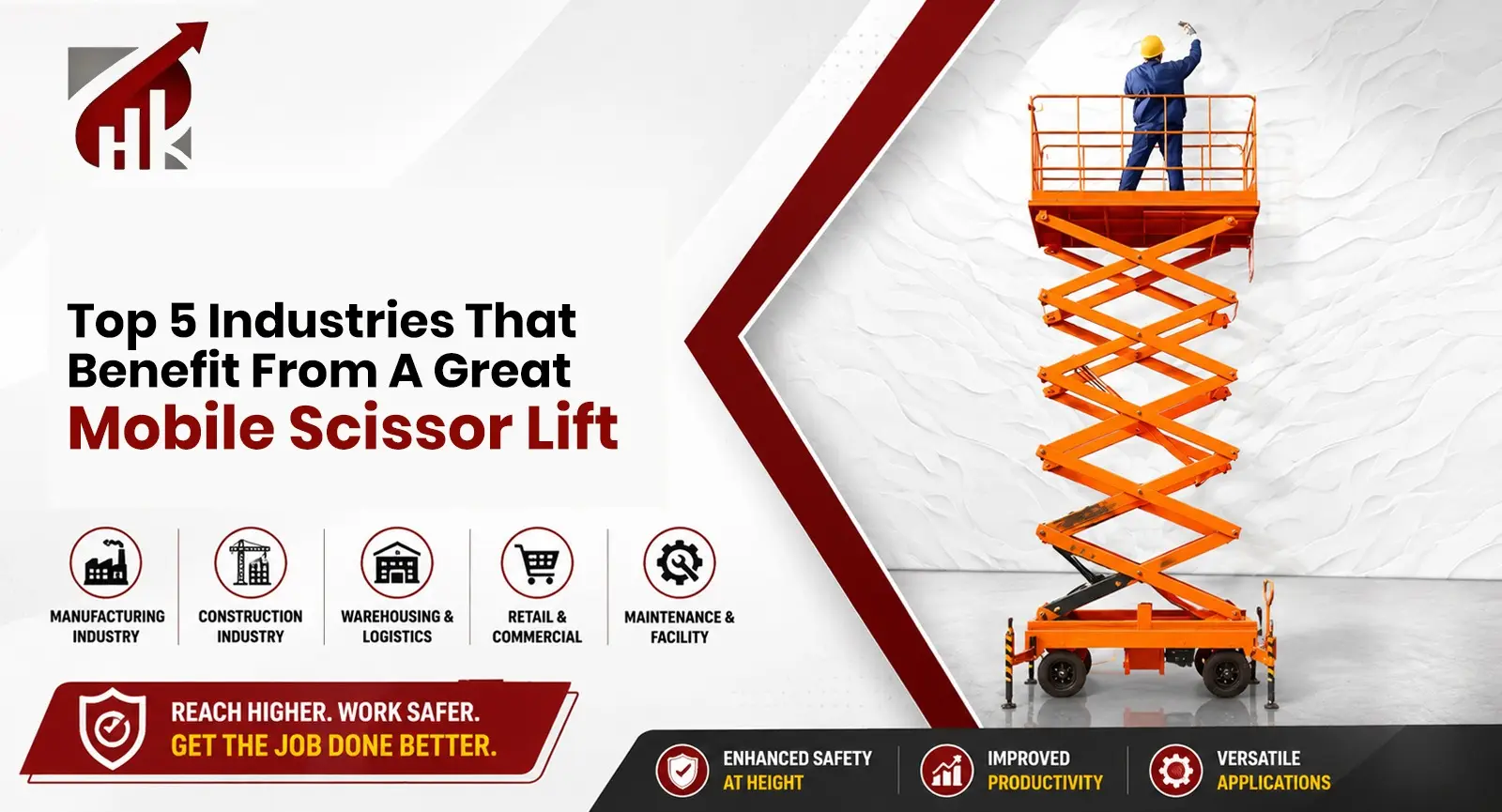
Overview – Working safely at height is not optional in any serious business, and a good mobile scissor lift makes that possible without the risks that come with ladders or makeshift platforms. Across warehouses, factories, and construction sites, this one piece of equipment keeps showing up again and again. This blog looks at the five industries where it genuinely earns its place and why each of them relies on it so heavily.
Table of Contents
Introduction
Some equipment is nice to have. A mobile scissor lift is closer to necessary, at least in industries where reaching height safely is part of the daily routine. Ladders wobble, scaffolding takes time to set up, and neither gives you the stable working platform this machine offers. Five industries in particular depend on it heavily, and understanding why helps explain just how versatile this equipment really is.Warehousing and Logistics
High racking is the norm in most modern warehouses, and getting up there safely is a daily challenge.- Stock retrieval from upper shelves becomes far less risky with a stable platform under the worker’s feet, rather than a ladder propped against a rack.
- Shelf maintenance and racking repairs happen more often than people expect, and a scissor lift platform makes this work faster and safer.
- E-commerce growth has pushed warehouses to build taller, denser storage, and that alone has driven a lot of the demand for this kind of equipment in recent years.
- A mobile lift table variant, built more for lifting pallets and goods than for lifting a worker, also finds heavy use here, moving loads between floor levels without needing a full elevator installation.
Construction Sites
Construction work rarely happens at ground level for long, and this is where a mobile scissor lift proves its worth every single day.- Ceiling work, drywall installation, and steel structure assembly all need workers positioned safely at height, often for extended periods.
- Painting and façade maintenance benefit from the stability a scissor lift gives, compared to the constant repositioning a ladder demands.
- Sites change layout constantly as work progresses. Being able to move the lift easily from one area to another, rather than rebuilding scaffolding each time, saves real hours across a project.
- Larger, heavy-duty units handle bigger loads and reach greater heights, which matters on sites doing structural or façade work at multiple stories.
Manufacturing and Industrial Plants
A production line does not stop easily, so servicing equipment at height has to happen without bringing the whole facility to a halt.- Overhead machine maintenance and equipment installation: these are tasks an industrial scissor lift ends up handling almost every day on a busy factory floor.
- Assembly work sometimes keeps a worker positioned at a fixed height for long stretches at a time, and a stable platform holds up far better here than a fixed ladder ever could, both for fatigue and for safety.
- Continuous shift operations put real strain on equipment. A lift running constantly needs sturdier bearings and hydraulics than one that only gets used occasionally, so duty cycle is worth checking before buying.
- Some plants have started integrating their lifts directly with automated systems now, matching platform height to conveyor speed so the line does not bottleneck at the handoff point.
Automotive Workshops
Vehicle assembly and servicing both lean heavily on precise, adjustable height access, which is exactly where compact lift designs earn their keep.- On an assembly line, a low-profile mobile scissor lift suits the job well, since vehicles only need to be raised enough for underbody access, without the bulk a larger platform lift would bring.
- Component installation on bigger vehicles, trucks especially, often calls for a stable working height that a standard jack simply cannot provide safely.
- Workshops that service more than one vehicle type benefit from adjustable capacity. A lift built for just one size limits how flexible the shop can be across different jobs.
- Falling under the wider category of material handling equipment, this same lift often ends up doing double duty, moving parts and assemblies around the workshop floor as well.
Retail and Facility Maintenance
Away from heavy industry, plenty of everyday commercial spaces rely on this equipment too, just for different reasons.- Lighting repairs, signage installation, and ceiling work in retail spaces all need safe, stable access, especially during hours when the store is closed to customers.
- Event venues use scissor lifts for stage setup, rigging, and lighting installation, where speed and stability both matter under tight deadlines.
- Facility teams managing HVAC systems, fire safety equipment, and general building upkeep find a hydraulic scissor lift far more practical than repeatedly setting up scaffolding for routine checks.
- Compact electric models suit indoor commercial spaces well, since they run quietly and do not produce the emissions a diesel-powered unit would.
Where HK Industries Fits
HK Industries manufactures a range of mobile scissor lift models built for the kind of daily, demanding use these five industries actually put them through. Whether your work involves warehouse racking, construction sites, factory floors, or facility maintenance, it may be worth discussing your specific height and load requirements with the team, and they are available to help you find the right fit for your work.Frequently Asked Questions
Which industries use mobile scissor lifts the most?
Warehousing, construction, manufacturing, automotive, and retail or facility maintenance are the five industries where this equipment sees the heaviest daily use, though it shows up in many other settings too.
What is the difference between a mobile scissor lift and a stationary one?
A mobile unit can be moved around a facility on wheels, while a stationary lift stays fixed in one location, often at a loading dock or a permanent production line position. The right choice depends on how often the work location changes.
Can the same mobile scissor lift work for both indoor and outdoor use?
It depends on the model. Electric units generally suit indoor work well, since they run quietly without emissions, while diesel-powered units are usually better suited to rougher outdoor conditions.
How do I decide what load capacity I need in a mobile scissor lift?
Consider both the weight of workers and any tools or materials being carried up together, and choose a lift rated comfortably above that combined figure rather than one that just meets it exactly.
