
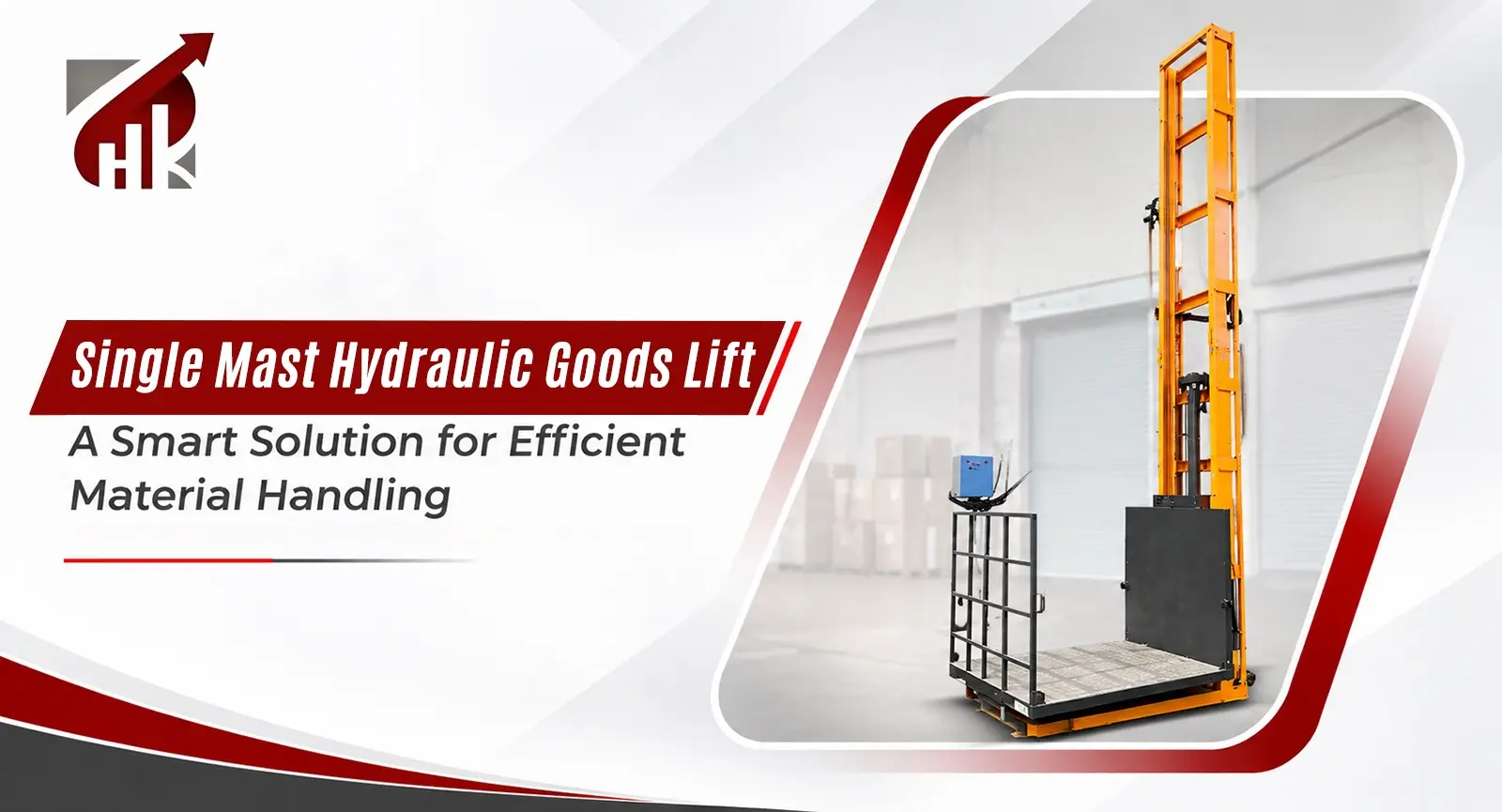
Quick Summary: A single mast hydraulic goods lift raises cartons, pallets, and tools between floors on one compact column. This article explains how it works, how to read capacity and height figures, which safety features matter, and how to prepare your site.
Table of Contents
- Introduction
- How the Single Mast Hydraulic Goods Lift Moves Goods From One Level to the Next
- Safety Features Worth Checking While Buying a Single Mast Hydraulic Good Lift
- Where Single Mast Lifts Are Used
- Choosing Between Single Mast and Double Mast Designs
- Five Signs Your Site Needs a Goods Lift
- Buying Mistakes to Avoid While Buying a Single Mast Hydraulic Goods Lift
- Conclusion
Introduction
Moving a heavy load up one floor sounds simple until you watch a team do it by hand. Cartons tilt on staircases, drums scrape walls, and someone always ends up carrying more than they should. A single mast hydraulic goods lift is used to lift all these things easily and safely. It is an industrial lifting machine that carries goods vertically between floors or levels, with a wall support on one side and three open sides for loading and unloading. A hydraulic cylinder and power pack drive the platform, so the effort comes from the machine instead of your workers’ backs. Factories, warehouses, retail stores and logistics operations use it to save floor space and keep material flowing. This article explains how the lift works, which features matter, where it fits best, how it compares with a double mast model, and which buying mistakes cost money. It also answers the questions buyers ask most, so you can shortlist the right lift with confidence.
How the Single Mast Hydraulic Goods Lift Moves Goods From One Level to the Next
The design is simpler than it looks. The lift stands against a wall, and that wall support gives the structure its stability. The other three sides stay open, so operators can load a pallet or trolley from whichever direction suits the layout. When the operator presses the control, the power pack pushes hydraulic fluid into the cylinder. That pressure raises the platform to the next level. Releasing the fluid brings it back down.
This arrangement keeps the footprint small, which matters in older buildings where every square metre counts. One caution applies: the wall must be strong enough to carry the support, so inspect it before you place an order.
Safety Features Worth Checking While Buying a Single Mast Hydraulic Good Lift
Not every feature carries the same weight. These are the ones that shape daily performance, and these are the things to check carefully while buying a single mast hydraulic goods lift:
- Compact design: Saves floor space in tight warehouses.
- Strong, durable construction: Holds up under repeated lifting cycles.
- High load capacity: Confirm the exact rating for your heaviest pallet.
- Customizable platform dimensions: Match the platform to pallets, drums or machinery.
- Safety elements: Ask which protective devices come as standard.
- Simple controls: Keep operation simple for new staff.
- Easy installation: Reduces downtime during setup.
- Hydraulic power system: Built around a standard cylinder and power pack.
Ask any supplier to confirm each of these in writing, because a feature listed on a brochure only helps when it appears on your quote.
Where Single Mast Lifts Are Used
Single mast hydraulic goods lifts are used in warehouses, manufacturing, retail, logistics, construction, automotive, food and beverage, pharmaceuticals, chemicals and textiles. The common thread is repeated vertical movement of goods between two levels.
A textile unit, for example, can send fabric rolls from a ground-floor store to a stitching floor. A pharmaceutical warehouse can lift cartons to a mezzanine without staff carrying them up stairs. The product page also lists automobile lifting among its uses.
Choosing Between Single Mast and Double Mast Designs
You should start with considering your space and your loads. A single mast hydraulic goods lift suits sites where a wall can carry the support and floor area is tight. If your platform is large or your loads are unusually heavy, ask the supplier whether a double mast model fits better.
Do not decide from a catalogue alone. Send the supplier your heaviest load, the platform size you need, and the travel height between floors. Those three details settle most of the question.
Five Signs Your Site Needs a Goods Lift
If more than one of these sounds familiar, a goods lift deserves a look:
- Staff carry goods up and down stairs several times a day.
- Loads are too heavy or awkward for safe manual handling.
- Floor space is tight, and a ramp or extra staircase will not fit.
- Goods need to reach elevated storage areas often.
- Workers report strain or have had handling injuries.
Buying Mistakes to Avoid While Buying a Single Mast Hydraulic Goods Lift
Most complaints trace back to a handful of avoidable errors:
- Sizing for the average load instead of the heaviest one.
- Skipping a wall strength check before installation.
- Overlooking headroom and the loading space around the platform.
- Letting untrained staff operate the lift.
- Ignoring routine checks of hydraulic fluid, hoses and seals.
Avoid these five and your lift will serve you far longer with fewer surprises.
Conclusion
A single mast hydraulic goods lift is very useful when used carefully. Match the capacity to your heaviest load, check the wall, plan the site, and train your operators. Do that and the lift will move goods between floors for many years while protecting your people from avoidable physical strain. HK Industries builds these lifts in Ahmedabad with customizable platforms, so make sure you consider the working condition of your industry and then make the decision to buy the lift. Share your requirements with the team and let the lift carry the weight.
FAQs
What is a single mast hydraulic goods lift used for?
A hydraulic goods lift is used to move heavy goods, machinery and materials vertically between floors or levels of a building. Warehouses, factories, retail units and logistics operations use it to replace manual carrying and reduce lifting injuries.
How does a single mast lift differ from a passenger elevator?
A single mast lift carries goods, not passengers. Operators load and unload it through three open sides, and a hydraulic cylinder and power pack move the platform.
Can the platform size be customized?
Yes, the platform can be easily customized according to your working requirements. We offer customizable platform dimensions, so you can match the platform to your pallets, drums or machinery. Share your load details with the team for a suitable configuration.
What load capacity should I choose?
Choose a rating that covers your heaviest single load, not your average one. Include the weight of pallets, containers or trolleys riding on the platform, and confirm the final capacity with the manufacturer.
Where should I install the single mast hydraulic goods lift?
Pick a spot beside a wall that can carry the support, with clear access on the three open sides and enough room at each level. Check headroom before you finalise the position.
How often does the lift need maintenance?
Follow the schedule the manufacturer provides. As a habit, inspect hydraulic fluid levels, hoses, seals and safety devices regularly, and stop using the lift when you notice leaks or uneven movement.
